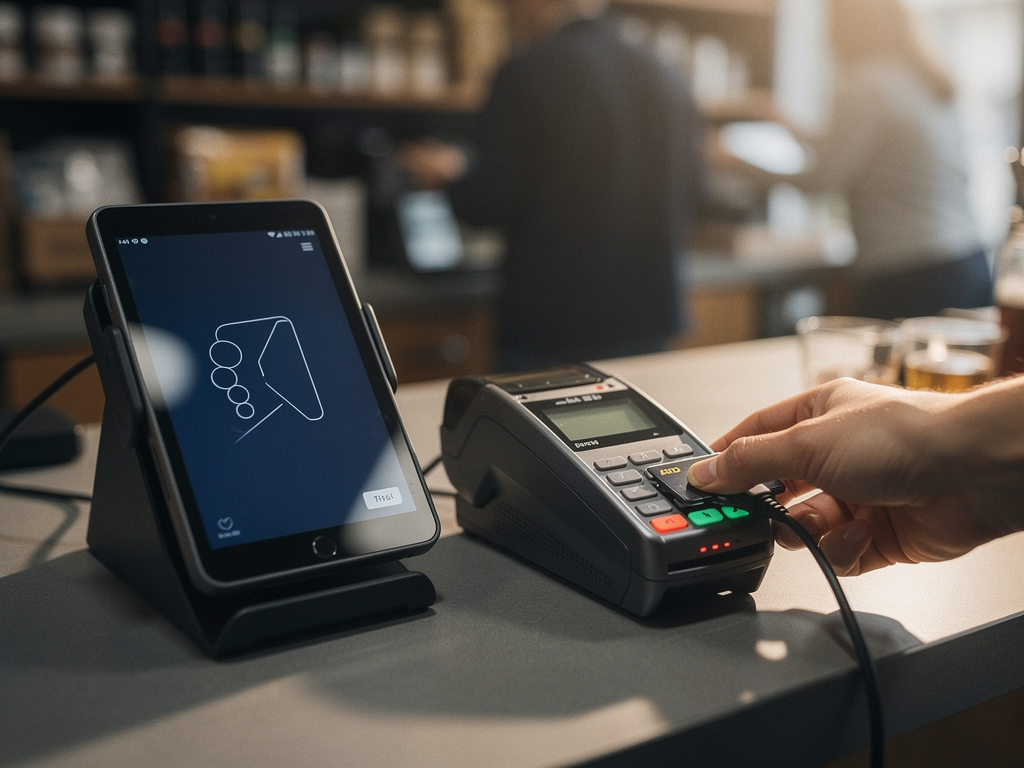

A merchant account is a specialized account that lets your business accept credit and debit cards, holding those funds briefly before they settle into your regular business bank account. You need one, or an aggregator that gives you a slot inside its own, to accept cards at all, and a true merchant account underwritten in your own business name is the more stable way to have it.
What a merchant account actually is
A merchant account is a specialized financial account that lets your business accept credit and debit cards. When a customer pays, the money does not jump straight into your checking account. It lands in the merchant account first, where it is briefly held and reconciled, and then it settles into your regular business bank account a day or a few days later.
Think of the merchant account as the holding bay between the card networks and your bank. You cannot accept card payments without one, or without an aggregator that lets you process inside its account. So the real question for most owners is not whether you need a merchant account. It is which kind you have, and whether it is built to keep your money flowing.
How the payment flow works, in plain English
A single card swipe touches several players in about two seconds. There is the cardholder, your customer. There is you, the merchant. There is the issuing bank, which gave your customer the card. There is the acquiring bank, which holds your merchant account. There are the card networks, Visa, Mastercard, Discover, and American Express, which set the rules and the interchange fees. And there is the processor, which carries the transaction data between all of them.
The flow runs in three stages. First, authorization: your terminal or checkout sends the card details to the processor, which routes them through the network to the issuing bank, which checks the funds and approves or declines in seconds. Second, clearing: at the end of the day you batch your approved sales, and the networks confirm the records and calculate the fees. Third, settlement: the funds move from the issuing bank through the network to your acquiring bank, which deposits the money, minus fees, into your account. For most businesses that deposit lands within one to five business days.
That settlement window is why a hold hurts so much. Your money is real and approved, but it sits in the merchant account stage until it is released. Who controls that stage, and on what terms, is the whole game.
Processor, ISO, and aggregator: who is who
These three terms get used interchangeably, and the difference matters for your stability. A processor is the company that actually moves the transaction and the money. An ISO, or independent sales organization, resells and services merchant accounts on a processor's behalf, which is fine when it is transparent and a problem when it stacks its own markups and hidden fees on top of the processor's rates.
An aggregator, also called a payment facilitator or PayFac, is a different model entirely. Square, Stripe, and PayPal pool thousands of businesses under one master merchant account, and you process as a sub-merchant inside it. That is why their signup takes five minutes with little underwriting up front. The trade-off is that they review your business after you start processing, so the risk check arrives when it is already too late to plan around.
Going direct to a true end-to-end processor removes the middleman markup an ISO can add and the shared-bucket exposure an aggregator creates. Our companion article, Aggregator versus merchant account: why does Stripe freeze funds but a real account does not, goes deeper on that comparison.
Do you actually need one?
If you want to accept cards, taps, or digital wallets at all, then yes, you need a merchant account or an aggregator slot, because there is no card acceptance without one. The deeper question is whether you can keep running on cash and checks instead, and for most businesses the honest answer is that you cap your own growth if you try. The large majority of customers reach for a card, a tap, or a phone first, and a cash-only counter quietly loses every one who is not carrying cash, every online sale, and every customer who asks whether you take Apple Pay.
So the practical choice is not cards versus no cards. It is a real merchant account versus a borrowed slot inside someone else's. The first is underwritten to you, with a direct relationship and a stable footing. The second is fast to open and quick to freeze.
Why a true merchant account is the stable choice
A true merchant account is underwritten in your own business name before you process. That up-front review usually takes a few business days, and it establishes a real risk relationship instead of an algorithm deciding your fate mid-sale. You are not a slot inside someone else's account that can be paused the moment a system sees a number it dislikes.
With North you get your own underwritten merchant account, reviewed properly up front, with fast funding and live human support if a question ever comes up. North is the largest privately owned processor in the country and a true end-to-end processor, so your transactions and your data are not passing through extra third-party hands. Send me your last statement for a free statement review and I will tell you exactly which model you are on today, then show you North's published rates on the rates page so you can see real cost versus markup before you decide anything.
Want this read for your own statement?
Send your last processing statement and Alex will show you your true effective rate, what is interchange, and what is pure markup. It costs nothing either way.